
FY 2025 marked a strong year of financial delivery for MTN, with performance meeting and, in several areas, exceeding our medium‑term guidance. The Group delivered solid momentum across its key financial metrics, supported by disciplined execution and a more stable macroeconomic environment in several key markets.
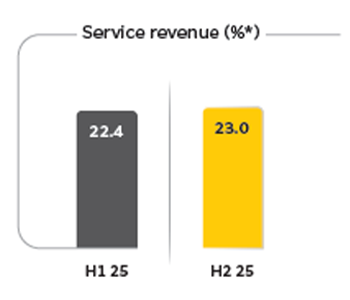
Service revenue increased by 22.7% in constant currency to R218.5 billion, representing the strongest topline growth achieved by the Group in over a decade. This performance was led by MTN Nigeria and MTN Ghana, alongside continued momentum across the broader portfolio. Growth was underpinned by sustained demand for data and fintech services, with data revenue increasing by 36.4% and fintech revenue by 23.2% in constant currency.
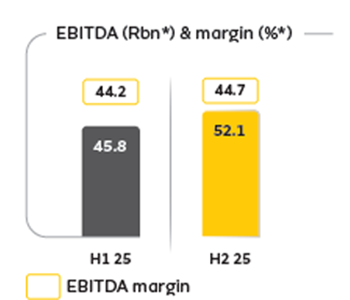
The topline momentum translated into strong earnings growth and margin expansion. EBITDA (before once‑off items) increased by 36.8% in constant currency to R98.5 billion, with the EBITDA margin expanding by 5.4 percentage points to 44.5%, reflecting operating leverage and disciplined cost management. The expense efficiency programme progressed ahead of schedule, delivering R3.6 billion of savings in the year and R7.4 billion cumulatively, effectively achieving the original three‑year target with a year remaining.
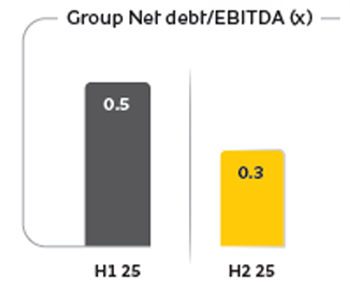
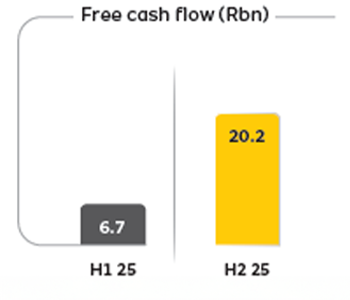
Cash generation strengthened materially. Operating FCF before spectrum and licence payments increased by 81.7% to R57.1 billion, while FCF rose to R26.9 billion. Capex (ex‑leases) amounted to R38.5 billion, with capex intensity of 17.0%, within the guided range. The year ended with a strong balance sheet, with Group net debt‑to‑EBITDA at 0.3x and liquidity headroom of R43.1 billion.
Ambition 2025 aimed to accelerate growth, improve returns, drive capital efficiency, strengthen cash generation and materially de‑risk the Group's balance sheet. We believe the bCAF was sound and provided effective guardrails for strategy execution and risk management through a volatile period. As we transition to Ambition 2030,, we have refined our CAF to better align with our strategic goals.
Throughout the Ambition 2025 period, service revenue demonstrated consistent growth at an average rate above Group blended inflation, driven by continued commercial momentum and disciplined execution. Structural cost efficiency was instrumental, with the Group achieving cumulative EEP savings of R16.4 billion. These savings contributed to margin expansion and improved earnings quality, despite a volatile macroeconomic environment.
Disciplined capital allocation was maintained, resulting in an average capex intensity of 17.6% and R180 billion in cumulative investment over the period. This allowed us to keep investing in high–growth areas, which in turn helped us to remain competitive.
Portfolio transformation continued, with asset realisation proceeds totalling R22.6 billion.
Returns improved significantly, with adjusted ROE reaching 25.6% by the end of the period. The balance sheet was also de‑risked: Holdco leverage was reduced to approximately 1.3x (from about 2.2x in 2020), and non‑Rand debt decreased to ~16%.
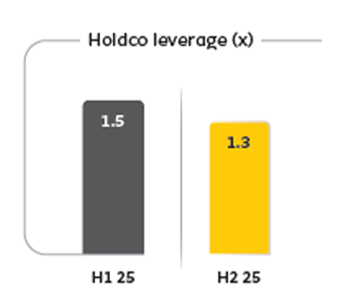
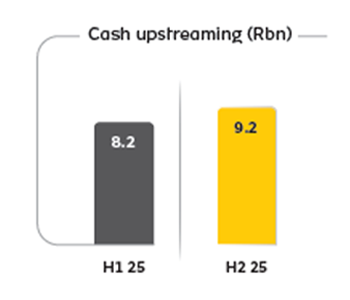

Capital allocation has been a critical enabler of MTN's strategy execution and risk management, and the framework applied under Ambition 2025 provided effective guardrails for investment, balance sheet discipline and capital returns through periods of macroeconomic volatility.
As part of the transition to Ambition 2030, the enhanced CAF will be centred on four priorities aligned to the key medium‑term objectives:
First, MTN continues to prioritise disciplined investment in organic growth, ensuring sufficient capital is deployed to sustain leading network and platform capabilities across connectivity, fintech and digital infrastructure.
Second, maintaining a healthy and resilient balance sheet remains a key pillar, with continued focus on prudent leverage, liquidity and currency risk management.
Third, the CAF incorporates an enhanced shareholder remuneration framework that reflects improved earnings quality, cash generation and balance‑sheet strength. The remuneration framework is now anchored on equity free cash flow (EFCF), with improved cash upstreaming from markets.
Finally, the CAF allows management to retain flexibility to pursue value‑accretive inorganic opportunities that meet our rigorous financial and risk assessment criteria. Overall, the streamlined framework supports disciplined execution of Ambition 2030.

The Board had guided a minimum dividend of 370 cents per share for FY 2025. Considering the significantly improved operating and financial performance, the Board declared a dividend of 500 cents per share, representing a 45% increase on the prior year and materially ahead of the guidance provided. This outcome reflected stronger earnings, improved cash generation and continued progress in restoring balance sheet strength, while demonstrating the underlying capacity of the business to deliver enhanced shareholder returns.
As MTN exits Ambition 2025, the Group is now well positioned to move to a clearer and more predictable medium‑term shareholder remuneration framework.
The Group targets annual distributions of 40% to 60% of EFCF, comprising a minimum cash dividend of 40%, with the potential for a further 20% through additional dividends and/or an opportunistic share buyback programme, subject to Board approval and market conditions.
Overall, the CAF supports sustainable long‑term value creation by improving predictability and downside protection, while maintaining the flexibility needed to invest, remain resilient, and grow through different market environments.
The shift from ROE to return on capital Employed (ROCE) reflects an evolution in how MTN measures performance and value creation, aligned to the capital‑intensive nature of the business and stakeholder expectations.
MTN operates in a highly capital‑intensive industry, requiring sustained investment in networks, spectrum, and digital platforms. While ROE remains a useful measure of shareholder returns, it is influenced by capital structure, leverage and equity movements, and does not always provide a clear view of how effectively the Group deploys its total capital base.
ROCE provides a more appropriate lens by measuring operating profitability relative to capital employed, offering a clearer assessment of capital efficiency and operational performance, independent of financing structure. It also reduces distortions associated with equity volatility arising from foreign‑exchange movements, impairments or balance sheet restructuring.
The change reflects extensive engagement with investors and governance stakeholders, who increasingly emphasised the importance of return metrics that align closely with capital allocation decisions and long‑term value creation. In our view, ROCE provides a clearer line of sight between investment decisions, operating performance and returns.
Importantly, ROCE also aligns directly with the CAF under Ambition 2030. Whether capital is deployed for organic growth, inorganic opportunities or shareholder returns, ROCE reinforces accountability for how capital employed generates value. Following a robust review involving management, the Board and relevant committees, ROCE was adopted as a more suitable long term metric for MTN's scale and complexity, supporting disciplined growth and sustainable returns.