


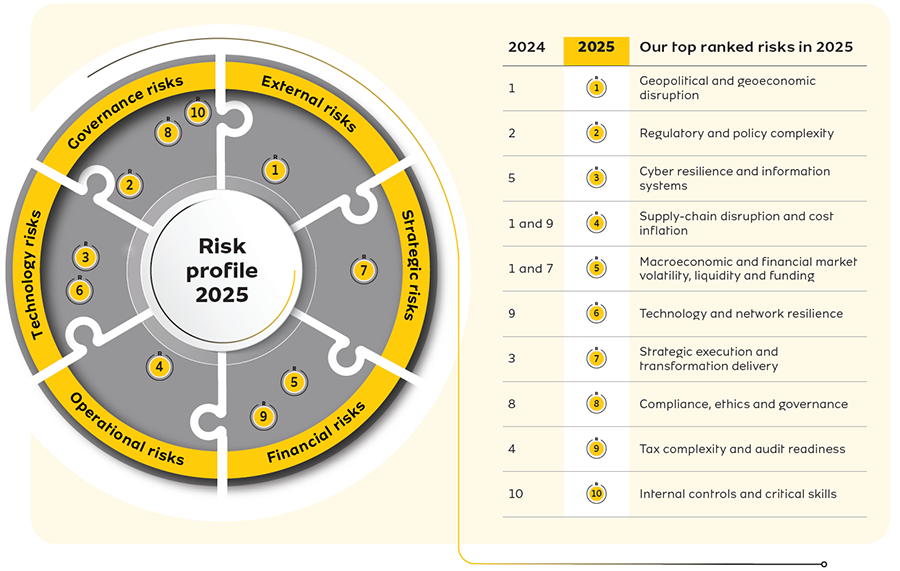
Alignment between the principal risk framework and Integrated Report top 10: MTN's ERM framework maintains a structured principal risk universe that supports completeness and consistency in risk identification and assessment across the Group. The universe uses a two-tier risk categorisation to enable uniform mapping of issues and to guide management toward complete risk coverage, and it is periodically refreshed to reflect changes in strategy, organisational structure and operations.
This structured universe strengthens decision-usefulness. MTN's risk approach prioritises risks based on likelihood, potential impact and the effectiveness of existing controls, enabling management and governance forums to focus attention and resources on the most material exposures and the most critical mitigation actions. In support of this, the combined assurance process reinforces that a clear understanding of the risk and control environment should inform the prioritisation of assurance activities and the allocation of the appropriate assurance focus and resources in response to material risks and control effectiveness.
From this broader universe, the Integrated Report presents a focused set of the Group's top risks, a market facing consolidation that brings together (i) the most material principal risk themes and (ii) the year's most relevant top of mind matters tracked through executive and Board risk oversight. This alignment provides stakeholders with a concise view of the risks that matter most for value creation and preservation during the reporting period, while maintaining an underlying risk framework that supports completeness, comparability across operating companies, and linkage to strategic decision-making and resource allocation.

MTN operates across markets where geopolitical fragmentation and geoeconomic competition are increasingly shaping the rules of trade, technology and market access. The world is becoming less anchored in predictable, rules-based co-ordination and more influenced by tariffs, sanctions, export controls and strategic resource policies. In parallel, local and regional conflicts are reshaping the global order by disrupting trade routes and energy markets and by increasing uncertainty in global value chains. For MTN, these dynamics can constrain the availability of critical network and IT inputs, increase cost and lead time volatility across infrastructure, devices and logistics, and heighten the need for enhanced sanctions, counterparty and logistics due diligence, recognising that risk increasingly sits in networks and interconnected supply chains rather than in any single geography. These shifts can also drive sudden policy changes and heightened compliance and security expectations, with knock on effects for operational continuity, the safety of our people and assets, and the pace at which MTN can execute strategic priorities.
 Natural
 Financial
 Intellectual
 Human
Human
 Manufactured
 Social

Geopolitical disruption can accelerate the strategic importance of reliable digital infrastructure and trusted platforms. MTN's scale reinforces its position as a critical enabler of digital and financial inclusion across Africa. The transaction to acquire all of IHS Holdings presents a significant opportunity to optimise digital infrastructure and improve network availability through more direct control. By positioning connectivity and fintech services as essential utilities, the Group can capture resilient demand as consumers prioritise digital access during economic shifts. Furthermore, as regional trade integration accelerates, MTN's Pan-African footprint positions it to serve as the primary platform for cross-border commerce and digital transformation.
MTN operates in a highly regulated sector where policy decisions and regulatory frameworks shape our operating environment. Regulatory compliance obligations span licensing conditions, spectrum allocation, quality-of-service (QoS) requirements, data privacy and governance laws, SIM registration and know-your-customer obligations, and competition and pricing regulations.
Across our markets, regulators continue to modernise legal frameworks and intensify enforcement particularly in areas such as QoS, consumer protection, pricing practices and market power remedies. This accelerates compliance timelines and creates a commercial challenge. Data protection and cybersecurity obligations are broadening, with several markets introducing data sovereignty and localisation requirements that directly influence technology choices and infrastructure investment. The emergence of AI governance frameworks and new technology regulations adds a further dimension of compliance complexity. Sanctions and export control requirements continue to evolve, impacting cross-border operations and technology procurement. MTN navigates this environment through a proactive and collaborative regulatory approach, with cross-functional teams engaging with regulators and policymakers to anticipate and address emerging issues while ensuring operational continuity.
Natural
Financial
Intellectual
Human
Manufactured
Social
MTN's proactive and collaborative regulatory approach positions the Group to help shape enabling policy frameworks that support investment, innovation and digital inclusion. Constructive partnerships with regulators and industry bodies strengthen trust, improve predictability and support balanced outcomes on issues such as spectrum, market structure, digital governance and fintech regulation. By anticipating policy change and engaging early, MTN can accelerate the delivery of connectivity, financial services and digital infrastructure across its footprint while reinforcing resilience and long-term value creation.
Cybersecurity remains a critical priority for MTN as the threat landscape continues to evolve, with increasingly sophisticated cyber-attacks, AI-enabled threats and ransomware campaigns targeting organisations globally. Such incidents can disrupt service availability and operational continuity, compromise personal and confidential data, and trigger regulatory scrutiny and penalties, particularly as data protection and cybersecurity requirements continue to evolve. Emerging threat vectors include vulnerabilities in third-party platforms, credential exposure, supply-chain compromises and a marked escalation in denial-of-service activity. The expanding digital footprint across our connectivity, fintech and digital infrastructure platforms widens the attack surface and increases dependence on resilient identity, API and third-party control environments. Enterprise-wide strategic security programmes remain central to improving resilience, strengthening governance of legacy and cloud environments and sustaining effective detection, response and recovery capability.
Natural
Financial
Intellectual
Human
Manufactured
Social
As digital adoption accelerates across MTN's markets, strong cyber resilience becomes a differentiator that underpins trust, service reliability and regulatory confidence. The continued uplift of security posture, DDoS resilience and incident response capability supports MTN's ability to scale digital and fintech services responsibly, protect customer and corporate information, and strengthen our reputation as a trusted partner to consumers, enterprises and governments.
MTN's supply chain reflects the scale and complexity of delivering connectivity, fintech and digital infrastructure across multiple markets, relying on a broad ecosystem of suppliers, service providers, logistics partners and other third parties that support network, IT and device delivery end-to-end. Escalating tariffs, evolving export controls on strategic inputs, disruption to freight routes and structural constraints in critical components can drive cost inflation and extend lead times. Market dynamics can also tighten into supplier controlled allocation and shorter pricing validity windows, reducing planning certainty and increasing the risk of delayed rollouts, budget overruns and affordability pressure for customers. Across MTN's footprint, these global pressures can be amplified by regional execution bottlenecks such as port congestion and clearance constraints, which raise landed costs and create greater variability in delivery schedules. Given this dependency profile, effective risk management increasingly requires strong third-party risk management (direct vendors and service providers) and growing visibility into downstream dependencies within supplier ecosystems (critical subcontractors, upstream suppliers and vendor platform dependencies that can propagate disruption even when MTN's direct supplier relationship appears stable). This is reinforced through strengthened supplier governance, due diligence and contract discipline, alongside early warning monitoring of lead times, landed costs, port congestion and vendor delivery performance, and broader oversight of vendor concentration, sourcing constraints and partner trade/sanctions exposure across critical suppliers and routes.
Natural
Financial
Intellectual
Human
Manufactured
Social
A more resilient and diversified supply chain strengthens MTN's ability to deliver network and digital infrastructure programmes predictably, protect customer affordability and sustain execution across its connectivity, fintech and digital infrastructure platforms. By improving forward visibility (early warning indicators), reducing concentration risk, and embedding supply resilience into planning and investment decisions, MTN can reduce volatility in delivery outcomes and improve capital efficiency, turning supply-chain discipline into a competitive advantage in service quality, speed of rollout and customer trust.
MTN's performance is linked to financial markets characterised by macroeconomic volatility, currency and interest rate fluctuations, and constrained access to hard currency in certain jurisdictions. These conditions can increase funding costs, complicate capital planning, and constrain the ability to repatriate cash and upstream dividends. During 2025, improving inflation trends, easing interest rates and stronger cash generation supported a meaningful improvement in the Group's financial position. However, structural risks remain, particularly around foreign-exchange exposure, capital market access and the predictability of cash repatriation from Opcs. In Nigeria, financial conditions improved materially with a return to profitability and a restoration of positive equity, although the market remains exposed to macroeconomic volatility and currency risk. The Group has strengthened balance sheet resilience through improved leverage, enhanced liquidity headroom and a more optimal funding mix with increased local-currency exposure. Nonetheless, shifts in global risk sentiment, renewed foreign-exchange volatility and changing monetary policy paths can reprice funding conditions quickly, affecting financial flexibility and investment optionality.
Natural
Financial
Intellectual
Human
Manufactured
Social
MTN's strengthened financial position and improved balance sheet flexibility create scope to strengthen local-currency funding solutions, expand partnerships with financial institutions and optimise capital allocation. Enhanced cash generation supports the Group's self-funding capacity, while proactive engagement with investors and regulatory bodies supports favourable policy outcomes and sustained confidence in MTN's long-term financial stability.
The rapid advancement of mobile and digital technologies, alongside growing customer demand for reliable connectivity, places sustained pressure on infrastructure resilience and service availability. Network congestion, constrained spectrum and exponential growth in data traffic require ongoing investment in network modernisation and capacity expansion. Legacy systems in certain markets constrain the pace of digital transformation and elevate operational risk. Energy security remains a concern, with grid instability and rising energy costs necessitating enhanced backup solutions and investment in renewable alternatives.
Geopolitical and geo-technological shifts, including vendor concentration, evolving trade controls and global supply-chain realignment, influence technology choices, procurement costs and the management of strategic technology partnerships. The concentration of telecoms innovation outside Africa creates a structural dependency on foreign vendors at foreign-currency rates. Emerging technologies, including AI-driven network automation, 5G, cloud platforms and LEO satellite solutions, present both risks and opportunities for scaling network capacity, service coverage and operational efficiency.
Reliance on third-party infrastructure providers remains a structural concern as traditional tower business models face increasing pressure.
Natural
Financial
Intellectual
Human
Manufactured
Social
Investment in next-generation capabilities including AI, fibre, 5G and satellite connectivity positions MTN to improve productivity, raise service reliability and unlock new revenue streams, while supporting digital inclusion through expanded coverage and improved customer experience. Strengthening the resilience of critical infrastructure (connectivity, data centres and recovery capability) reduces the cost and frequency of disruption, enabling more predictable delivery of strategic programmes and better capital efficiency over time. As technology evolves, disciplined modernisation and stronger resilience help MTN shift from 'keeping systems running' to enabling future-ready platforms that can scale new services and partnerships with greater confidence.
MTN's strategic ambition depends on delivering large, multi-market transformation programmes with a consistent pace and quality, across Connectivity, Fintech and Digital Infrastructure, while modernising platforms, scaling digital capabilities (including AI), and strengthening customer experience and operational efficiency. The most material execution risk is delivery friction, in which timelines and outcomes are affected by interconnected dependencies (infrastructure readiness, regulatory approvals, partner performance, and constrained delivery capacity). Internal risk reporting highlights that execution is increasingly constrained by network, fibre, data centre and towerco dependencies, and that delays in resilience upgrades, fibre rollout and infrastructure modernisation can directly undermine strategic delivery timelines. Transformation delivery also introduces 'change risk'. Portfolio optimisation and transformation initiatives can fail to deliver benefits if sequencing, governance and adoption are uneven across markets, or if critical assumptions change without timely course correction. Group delivery governance guidance explicitly requires disciplined management of delivery risks and assumptions reflecting the importance of tight change control in complex programmes.
Natural
Financial
Intellectual
Human
Manufactured
Social
Strong execution and disciplined transformation delivery convert MTN's strategy into tangible outcomes for customers and investors: faster time to market, improved reliability and customer experience, and more efficient capital deployment across the three platforms.
Continued investment in digital platforms, network capabilities and emerging technologies supports enhanced customer experiences, improved operational efficiency and the development of new revenue streams.
By maintaining strategic agility, strengthening execution discipline and leveraging its scale and market presence, MTN is well positioned to capture evolving opportunities and deliver sustainable value to stakeholders.
Regulatory complexity and evolving compliance requirements across multiple markets pose significant challenges, with increasing scrutiny from authorities across a broad range of areas, including SIM registration, tax compliance, spectrum licensing, QoS and financial services regulation. Tight regulatory timelines and shifting policy environments heighten the risk of non-compliance, which may result in financial penalties, new licence conditions or operational disruptions. As MTN's platforms continue to scale, additional requirements relating to financial crime compliance, consumer protection and market structure introduce further complexity.
Data privacy and protection are key areas of focus, particularly in relation to data processing, cross-border data flows and cybersecurity. Evolving sanctions and trade-related requirements, influenced by global geopolitics, require ongoing monitoring and alignment. Strengthening compliance frameworks, enhancing monitoring capabilities and embedding regulatory alignment into operational strategies are critical to mitigating compliance risk and supporting long-term business resilience.
MTN's licence to operate is shaped by: (i) regulatory scrutiny and enforcement across markets, and (ii) stakeholder expectations that MTN demonstrates strong governance, ethical leadership and reliable compliance execution at scale. This exposure is not only financial. Compliance failures can trigger operational disruption (e.g., forced disconnections or licence constraints), weaken customer trust and elevate reputational risk, particularly where incidents involve customers, or attract sustained regulator focus. Ethics and governance are both critical. Culture and conduct risks (including conflicts of interest, gifts and hospitality governance, and 'speak up' confidence) can become root causes of compliance failures, fraud and misconduct. In 2025, MTN completed a Group-wide ethical culture survey (supported by Ethisphere), showing an overall score improvement to 82.3 (from 78.8 in 2022) with strong participation (66%). From a governance perspective, MTN's compliance and ethics posture relies on effective policy governance, clear accountability and coherent assurance across the lines of defence. Meeting the requirements of King V, including an 'apply and explain' disclosure approach and greater integration of leadership and ethics expectations, reinforces the need for disciplined governance and transparent external reporting.
Natural
Financial
Intellectual
Human
Manufactured
Social
Strong compliance, ethics and governance are value enablers supporting predictable operations, protecting licences, and strengthening trust with customers, partners, investors and regulators. The positive direction in MTN's ethical culture survey results provides a platform to deepen a speak up culture, reduce pressure-driven misconduct risk and strengthen leadership consistency across the footprint.
At the same time, maturing governance frameworks particularly around policy execution, combined assurance and responsible AI create opportunities to improve decision quality, reduce the cost of compliance, and embed 'compliance by design' into transformation programmes, enabling MTN to scale connectivity, fintech and digital infrastructure growth with confidence.
MTN is committed to meeting all tax obligations across its operating footprint and to maintaining transparent, cooperative relationships with revenue authorities. The Group operates in a tax environment that continues to evolve through domestic reforms and international developments, increasing the complexity of cross-border compliance and reporting expectations.
As revenue authorities intensify focus on technical interpretations and audit methodologies, MTN's exposure increasingly relates to audit readiness and evidentiary defensibility, particularly in areas such as transfer pricing, permanent establishment assessments, and revenue reviews that rely on detailed operational and systems data (including CDR-based approaches). This is amplified by the technical nature of telecoms and digital platforms, where data flows span multiple systems and jurisdictions. In practice, this can create differing views on the application of tax rules to complex service arrangements, cross-border charges, and platform-based revenue streams, requiring structured engagement with authorities to align on facts, evidence and interpretation. The expansion of MTN's fintech and digital infrastructure platforms further increases the need for consistent entity structuring, clear documentation and multi-jurisdictional tax governance, as new revenue models and operating arrangements introduce additional obligations and interpretive complexity
Natural
Financial
Intellectual
Human
Manufactured
Social
MTN's proactive approach to tax governance strengthens trust with regulators and demonstrates leadership in tax transparency. By leveraging automation, enhancing internal controls and engaging constructively with revenue authorities, MTN can navigate evolving tax landscapes while optimising its structures. This approach mitigates financial risk and reinforces MTN's position as a responsible corporate citizen across its markets.
A proactive, transparent approach to tax governance supports stakeholder confidence. It helps protect long-term value by reducing uncertainty, strengthening the predictability of outcomes, and improving the efficiency of audit responses across markets. Strengthening audit readiness, particularly evidence discipline, data integrity and cross-functional co-ordination, also creates operational benefits beyond tax: better data governance, clearer accountability for critical records, and improved resilience of the control environment that supports reliable external reporting.
MTN's operating model spans multiple platforms and markets. This increases the risk that control execution becomes uneven, reducing the reliability of internal controls and assurance outcomes across the Group.
A key driver of this risk is the potential inconsistency in applying the Group internal control framework and methodologies across markets. Markets receive Group guidance on minimum control requirements and how those controls should be tested consistently. MTN's internal control programme addresses this need through standardisation of controls and benchmarking of key controls across markets, establishing a common baseline for critical processes. As MTN scales and professionalises governance in core functions, critical skills become a binding constraint. To address this, MTN has moved toward 'verticalisation' for certain core functions. In practice, this means local functional heads have dual accountability: operational accountability to local management and functional accountability to the Group functional head, with standards, priorities, performance expectations and escalation flowing vertically through the function. This approach is intended to strengthen consistency and line of sight into execution quality across markets.
Natural
Financial
Intellectual
Human
Manufactured
Social
A more consistent internal control environment improves compliance and enables execution. Standardised controls, reliable attestations and consistent evidence allow management and the Board to make faster, higher-quality decisions with greater confidence in the underlying information. Embedding minimum control requirements across markets reduces operational friction. It enables repeatable ways of working, reduces rework from recurring findings, and supports scalable transformation by ensuring that core processes operate predictably across different market conditions. Finally, 'verticalisation' creates value by strengthening specialist capability in areas where inconsistency carries high downside, security incidents, technical accounting judgements, and procurement/vendor governance. By aligning standards, escalation and performance expectations through verticalised operating models, MTN improves control reliability and resilience while building a deeper bench of critical skills across the footprint.